Nippon Life became a Signatory to the Equator Principles in April 2019.
The Equator Principles
The Equator Principles (EPs) is a risk management framework developed by financial institutions for identifying, assessing and managing environmental and social risks and impacts associated with projects. This framework is intended to provide minimum standards for due diligence and monitoring to support responsible risk decision-making.
Based on the “Performance Standards” of IFC (International Finance Corporation), a member of the World Bank Group, and the “World Bank Group EHS (Environmental, Health and Safety) Guidelines”, financial institutions establish their own policies, procedures and standards and develop internal management systems to assess and monitor how projects manage environmental and social risks and impacts.
The EPs apply to Project Finance and other financial products and services that meet the applicable criteria, regardless of project location or industry sector.*
Financial institutions that adopt the Equator Principles (EPFIs) assess whether projects subject to the EPs comply with the applicable EP requirements when providing financing. They do not provide financing to projects that do not meet those requirements.
As of the end of May 2026, 126 financial institutions globally have adopted the EPs, covering the majority of international project finance.
-
*
The EPs apply to the following financial products and services.
Project Finance
Project Finance with total project capital costs of US$10 million or more.
Excluding projects that have already been completed as of Financial Close.
Project-Related Corporate Loans
Project-Related Corporate Loans where all of the following three criteria are met:
-
1.
The majority of the loan is related to a Project over which the client has Effective Operational Control (either direct or indirect).
-
2.The total aggregate loan amount and the EPFI’s individual commitment (before syndication or sell down) are each at least US$50 million.
-
3.The loan tenor is at least two years.
Bridge Loans
Bridge Loans with a tenor of less than two years that are intended to be refinanced by Project Finance or a Project-Related Corporate Loan that is anticipated to meet the relevant criteria set out above.
Project-Related Refinance and Project-Related Acquisition Finance
Project-Related Refinance and Project-Related Acquisition Finance, where all of the following three criteria are met:
-
1.
The underlying project was financed in accordance with the EPs framework.
-
2.There has been no material change in the scale or scope of the project.
-
3.Project Completion has not yet occurred at the time of the signing of the facility or loan agreement.
Project Finance Advisory Services
Project Finance Advisory Services for projects with total project capital costs of US$10 million or more.
For more details, please visit the official Equator Principles website.
IFC Performance Standards
IFC has established the following eight Performance Standards (PS), which serve as environmental and social guidelines for its clients.
- PS1
- Assessment and Management of Environmental and Social Risks and Impacts
- PS2
- Labor and Working Conditions
- PS3
- Resource Efficiency and Pollution Prevention
- PS4
- Community Health, Safety, and Security
- PS5
- Land Acquisition and Involuntary Resettlement
- PS6
- Biodiversity Conservation and Sustainable Management of Living Natural Resources
- PS7
- Indigenous Peoples
- PS8
- Cultural Heritage
For more details, please visit the official International Finance Corporation (IFC) website.
World Bank Group Environmental, Health and Safety (EHS) Guidelines
The World Bank Group has created technical reference documents for environmental, health and safety that should be observed when carrying out projects. They consist of General EHS Guidelines for all industries and Industry Sector EHS Guidelines with additional guidance for specific industrial sectors.
For more details, please visit the official World Bank Group website.
Background to the Adoption of the Equator Principles
Nippon Life has emphasized harmonious coexistence with the environment, local communities and society, while sharing stable growth with companies and the economy as a whole. As part of its asset management operations, Nippon Life is enhancing its responsible investment activities by taking environmental, social and governance factors into consideration according to the characteristics of each asset class.
Nippon Life initiated engagement in project financing in 2013, set up the Structured Finance Department in 2017, and is also steadily accumulating transactions in overseas project finance. Projects that involve large-scale development could potentially have major impacts on the natural environment and local communities. With this recognition, Nippon Life adopted the EPs in April 2019 to ensure that sufficient consideration is given to environmental and social impacts when making decisions on project finance.
Our Initiatives
Internal Management System
Following the adoption of the EPs, Nippon Life has established internal policies and processes related to loan execution that incorporate the principles, along with policies relating to environmental and social considerations and an Environmental and Social Risk Assessment Manual that designates the assessment processes for such risks. In accordance with the manual, the Loan Department will implement primary assessments of environmental and social risks, and the Credit Department will carry out secondary assessments.
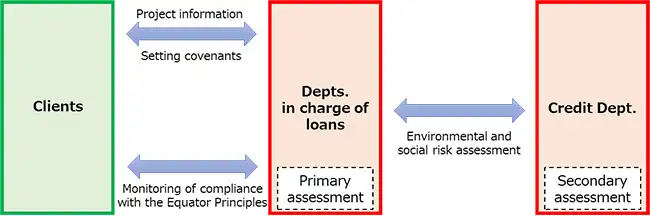
Internal Procedures for Confirming Compliance with the Equator Principles
-
1.
The Loan Department shall obtain the information required for the Screening Form (Note 1) for transactions subject to Environmental and Social Risk Assessment and complete the form with the necessary information.
-
2.Based on the information contained in the Screening Form, the Loan Department shall assess the level of impact for each item specified in the Applicability Checklist (Note 2) in accordance with the IFC Performance Standards, classifying the impact as Significant, Limited, or Minimal/None. The Loan Department shall then assign a preliminary category according to the level of impact and submit the required documentation to the Credit Department.
-
3.The Credit Department shall conduct a secondary review and determine the preliminary category. The results shall then be communicated to the Loan Department.
-
4.Based on the preliminary category, the Loan Department shall review the project’s environmental and social considerations, including the contents of the Environmental and Social Impact Assessment (ESIA), Environmental and Social Management Plan (ESMP), and other relevant documentation, and shall conduct Environmental and Social Due Diligence to determine whether the project meets the requirements of the EPs. Where necessary, the Loan Department shall consider revising the category. Upon completion of the review, the Loan Department shall submit the required documentation to the Credit Department.
-
5.The Credit Department shall conduct a secondary review and determine the final project category and the project’s compliance status with the EPs. The results shall then be communicated to the Loan Department and other relevant departments.
-
6.The Loan Department shall confirm the category and compliance determination received from the Credit Department. Where the Credit Department has identified matters requiring further investigation, the Loan Department shall address such matters accordingly.
-
7.The Loan Department shall confirm that the covenants applicable to the project category and host country have been appropriately incorporated into the final financing documentation.
-
Note 1
The Screening Form is a document used to collect basic information regarding a project’s environmental and social considerations when assessing the applicability of the EPs to project finance transactions and other in-scope financial products.
-
Note 2
The Applicability Checklist is a document used to assess whether a project finance transaction or other in-scope financial product meets the requirements of the EPs and to determine the appropriate project category.
Implementation of Environmental and Social Risk Assessment
For projects that are subject to the EPs, the Loan Department and the Credit Department conduct environmental and social risk assessments in accordance with the internal Environmental and Social Risk Assessment Manual to confirm whether the project’s environmental and social considerations meet the standards required by the EPs.
More specifically, in accordance with Principle 1 of the EPs, projects are classified into the following categories based on their potential environmental and social risks and impacts.
| Principle 1 |
Review and Categorisation |
|---|
| Category | Definition |
|---|---|
| A |
Projects with potential significant adverse environmental and social risks and/or impacts that are diverse, irreversible or unprecedented |
| B |
Projects with potential limited adverse environmental and social risks and/or impacts that are few in number, generally site-specific, largely reversible and readily addressed through mitigation measures |
| C |
Projects with minimal or no adverse environmental and social risks and/or impacts |
Nippon Life will then confirm the status of compliance with the EPs depending on the project's category classification. For instance, if a project has been classified as Category A, we will confirm whether the project meets the requirements of Principles 2 through 10 of the EPs.
Depending on the results of the assessment, we will agree with the client on the incorporation of Equator Principles covenants into the financing agreement, where appropriate.
| Principle 2 |
Environmental and Social Assessment |
|---|---|
| Principle 3 |
Applicable Environmental and Social Standards |
| Principle 4 |
Environmental and Social Management System and Equator Principles Action Plan |
| Principle 5 |
Stakeholder Engagement |
| Principle 6 |
Grievance Mechanism |
| Principle 7 |
Independent Review |
| Principle 8 |
Covenants |
| Principle 9 |
Independent Monitoring and Reporting |
| Principle 10 |
Reporting and Transparency |
Application of the Equator Principles
Projects subject to the EPs that reached financial close between January 1, 2025 and December 31, 2025 are listed below.
Nippon Life confirmed that these transactions met the requirements of the EPs through the process described above.
Project Finance Transactions
There was one Project Finance transaction that reached financial close between January 1, 2025 and December 31, 2025. The breakdown is shown below.
| Number of Transactions by Category | |||
|---|---|---|---|
| Category A | Category B | Category C | |
|
ー |
1 |
ー |
|
| Detailed Breakdown by Category | |||
| Sector | Category A | Category B | Category C |
|
Mining |
ー |
ー |
ー |
|
Infrastructure |
ー |
1 |
ー |
|
Oil & Gas |
ー |
ー |
ー |
|
Power |
ー |
ー |
ー |
|
Other |
ー |
ー |
ー |
| Region | Category A | Category B | Category C |
|
Americas |
ー |
ー |
ー |
|
Europe Middle East and Africa |
ー |
ー |
ー |
|
Asia Pacific |
ー |
1 |
ー |
| Designated Countries | Category A | Category B | Category C |
|
Designated Countries |
ー |
1 |
ー |
|
Non-Designated Countries |
ー |
ー |
ー |
| Independent Review | Category A | Category B | Category C |
|
Yes |
ー |
1 |
ー |
|
No |
ー |
ー |
ー |
Project-Related Corporate Loans
Not applicable.
Project-Related Refinance
Not applicable.
Project-Related Acquisition Finance
Not applicable.
Project Finance Advisory Services
Not applicable.
Monitoring Compliance with the Equator Principles
For covenants incorporated into financing agreements at the time of contract execution, Nippon Life regularly monitors compliance throughout the financing period by reviewing periodic reports submitted by clients and other relevant information. These covenants include, but are not limited to, compliance with environmental and social laws and regulations, as well as agreed action plans.
Since adopting the EPs in 2019, Nippon Life has monitored projects subject to the EPs in accordance with this policy.
Conduct of Internal Training
In addition to maintaining internal manuals, Nippon Life periodically conducts internal training, primarily for employees responsible for lending activities, to deepen their understanding of the EPs and the environmental and social risk assessment process.
Nippon Life will continue to promote awareness of environmental and social considerations throughout the organization through these training programs and other related initiatives.